
AI & Game Development
How to Vibe-Code High-Quality Browser Games
Four real experiments, original prompts and the human decisions that made the difference.
I have built browser-game experiments that I wanted to keep playing, and others that never quite matched the idea in my head. The difference was rarely how impressive the first AI response looked. It was whether the prototype had something worth developing — and whether the next changes made that experience better.
This is my practical workflow, drawn from a football manager, Paintball, a shooting-range experiment that led into Whiteout, and a music-driven game. It includes excerpts from the prompts I actually used, plus clearly labelled templates you can adapt. These are development examples, not a claim that every feature in every brief has shipped.
AI-assisted writing based on my game-development chats and interview. English quotations are labelled translations; new prompt templates are identified separately.

THE PERSON BEHIND THE PROJECTS
Lenard Schwenkschuster
Web design, vibe coding & application expert. I build and test browser tools, games and my own CMS, with a background in digital media and frontend development.
Human creativity beats AI planning and creativity — for now.
Lenard Schwenkschuster — personal interview, 30 October 2026; translated from German
1. Give the game a human idea before you give it more features.
I have been using planning mode more often. In my experience, the planned games tend to be more solid at the beginning, but sometimes also plainer. If I already have a concrete picture in my head, a detailed direct prompt often gets closer to that picture. A long planning process does not automatically give the result more depth.
For 3D browser experiments, Three.js is my personal starting point. Other browser-engine approaches I have tried have disappointed me, even when performance improved. That is a preference from these projects, not a benchmark proving that one engine is always best.
My useful distinction is this: ask for clarification when the idea is vague; keep the creative direction with yourself when the idea is specific. Describe what the player does, what the game should feel like, and which part must work first.
Adaptable starting template — newly written from this interview, not an original chat quote
Build a browser-game prototype around this idea: [your specific idea].
The player repeatedly: [core action and feedback].
The intended feeling is: [pace, atmosphere and reference qualities].
Use Three.js for this 3D prototype.
Keep the first playable version focused on [one scene / one loop].
Ask questions where mechanics are ambiguous. Preserve my creative direction instead of replacing it with generic features.
Explain what you will build first and what you will deliberately leave for later.
2. Football manager: test the potential, then build reusable systems.
The football manager is where scaling worked particularly well for me. A prototype quickly showed that the game had potential. From there the process became: idea, graphics, more ideas, then a much larger scope.
The important asset idea was modular faces. Rather than request a separate finished portrait for every generated player, I described age groups and combinable elements. Hair and glasses would sit on top of a base face. That gives a large simulation a reusable visual system instead of a pile of unrelated pictures.
Original German excerpts from my football-manager starting prompt
Haare, Brille etc wird nachträglich drübergelegt so bekommen wir optisch varianz.

Baue jetzt so, dass wir das Spiel immer weiter intelligen ausbauen können (auch international gedacht). Aber erstmal Fokus komplett auf Deutschland :)
In English: add hair, glasses and other elements as separate layers to create visual variety; make the game extensible, but focus on Germany first. The rough spelling is preserved because these are actual prompt excerpts.
Reusable does not mean correct on the first attempt. I had to ask for fixes when faces looked wrong or the layers did not sit properly. This was a specific visual problem to correct, not a reason to ask for another hundred assets.
Original German correction prompts — excerpts
schau nochmal wegen den Gesichern. Das passt noch 0,0. Haare und andere assets müssen auch echte grafiken sein kein CSS

Achte bei den Gesichtern wieder speziell auf dass Haare und Assets gut sitzen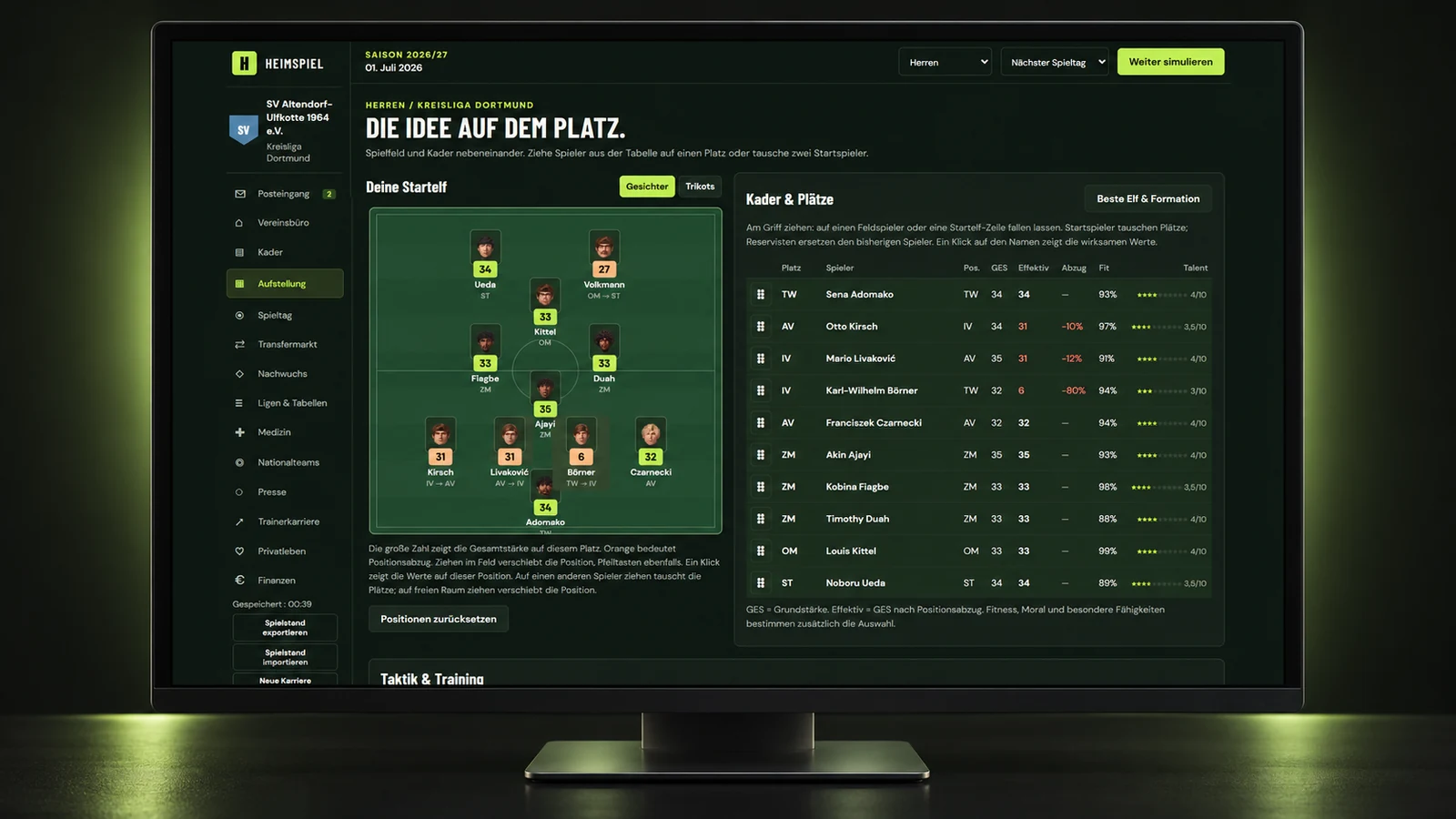
Once the foundation was useful, I expanded the scope to parallel country and league selections, international moves, competitions and a wider simulated world. The screenshot shows one stage of that development. It does not establish that every real-world squad, photo or statistic is complete or current.
Original German expansion prompt — opening excerpt
Okay, man soll jetzt am Anfang aus mehreren Ländern auswählen können welche Länder + Ligen man simmulieren möchte (parallel) das System soll auch vorschlagen, wann vermutlich ein Limit erreicht ist.The reusable lesson is to scale a system that already has potential. Define how the assets combine, correct visible mismatches, and then expand the simulation. Keep the requested world size separate from what you have actually verified in a build.
3. Paintball: gameplay can make up for rough edges.
For Paintball, finding suitable assets was a big step. Some animation could still look rough, but good gameplay made up for a lot. On the other hand, paintballs hanging in mid-air were not a cosmetic problem: a shot needs to reach something and produce understandable feedback.
The point at which it finally felt like a game was when sound, pace and gameplay came together. That is different from simply having a running scene with a weapon on screen.
When sound, pace and gameplay are really in sync, it finally feels like a game rather than a test you want to throw away.
Lenard Schwenkschuster — personal interview, 30 October 2026; translated from German
Original German Paintball starting prompt — excerpt
Lass uns ein hyperrealistisches Paintball Spiel bauen in Three.js. Bodycam optik, farbsplatter, fast paced.. schön animiert. Das Spielfeld muss ja nicht so krass sein (Luftkissen und abgegrenzter raum) Entweder in der halle oder freie Natur.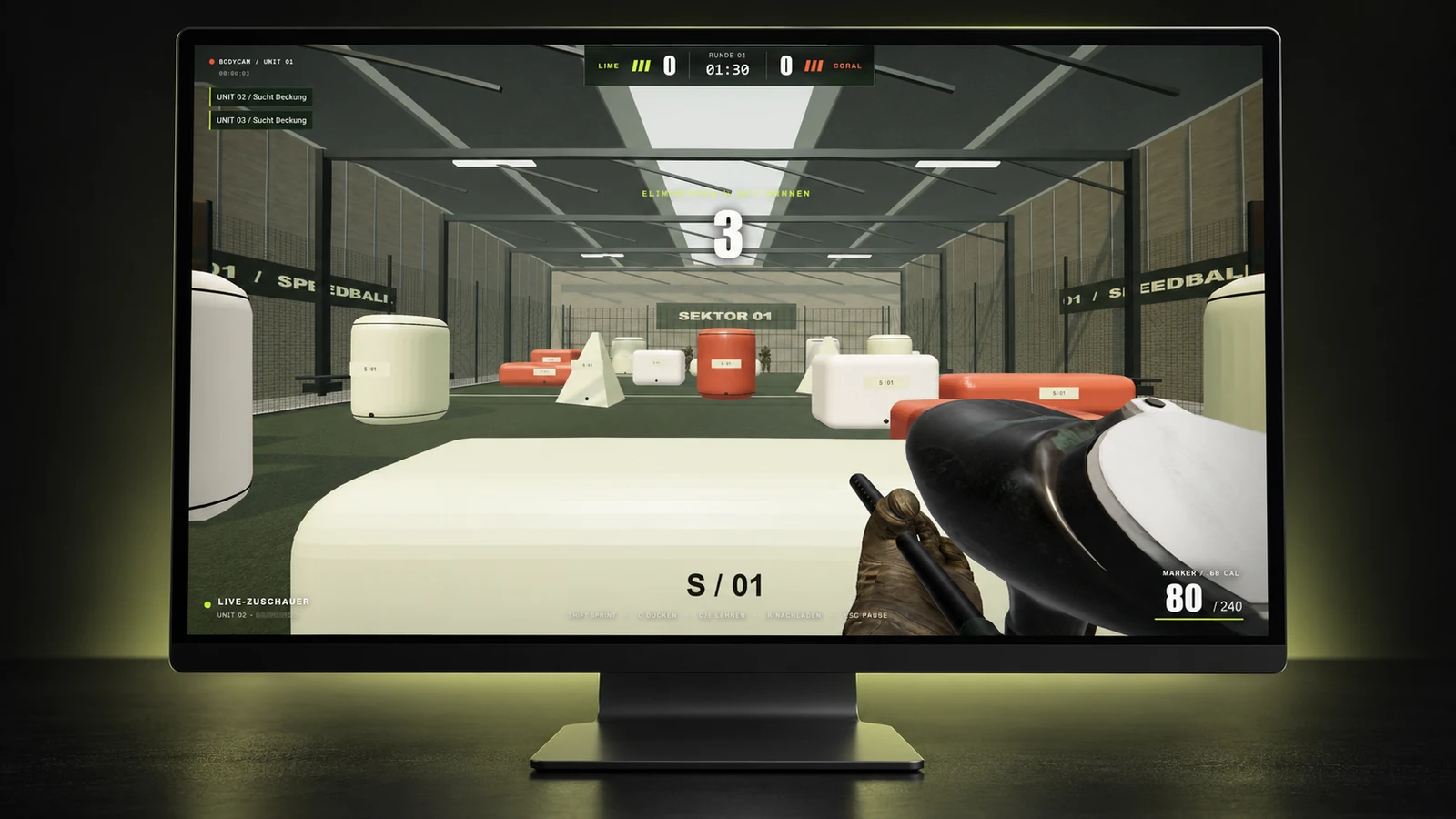
Adaptable bug-fix prompt — newly written from the issue I described
Reproduce this problem before changing anything: after firing, paintballs sometimes remain suspended in the air.
Check projectile movement, collision, impact feedback and cleanup.
Keep the existing movement and pace. Fix this one issue before adding more features.
Show me a playable before/after check, then report what is still uncertain.
4. Whiteout: a tech demo can be a useful starting point, not the final game.
The earlier shooting experiment helped me see what was possible. Then I wanted a different direction: horror, a demon, more action and more of a complete game feeling. The technical demo was a foundation to learn from, rather than a commitment to keep every decision forever.
My vibe-coding process goes back and forth. I sometimes remove extensions and start a new version with a more deliberate direction. It is easy to keep asking for one more conversion of a build that no longer fits the intended game. That can consume a lot of time and credits.
I would rather stop early and start again than waste lots of credits and time on “somehow rebuild it for me.”
Lenard Schwenkschuster — personal interview, 30 October 2026; translated from German
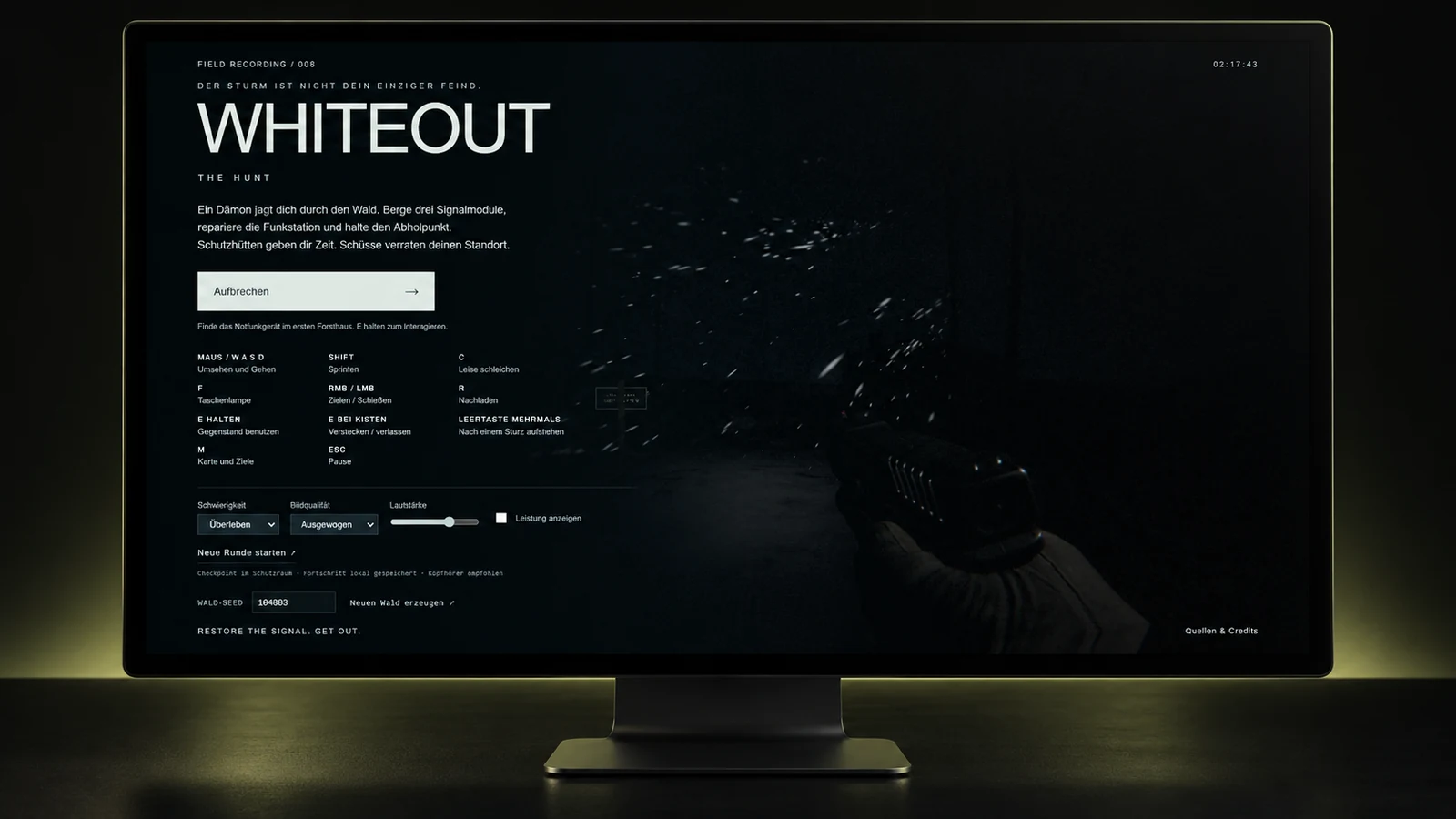
My practical takeaway is to keep a known-good version before a major change. State what should survive — for example, movement or weapon handling — and what the new version is trying to explore. Treat that as a focused experiment, not proof that the original work was wasted.
5. Music-driven games: an idea can be playable without matching your imagination.
The music experiment was harder. In my head, music had waves, rhythm and beats, and the AI would somehow turn that into the right game. The result eventually felt like a full game, but it was not what I had originally imagined. Later, I also asked for YouTube links as an additional way to bring music in. That was another feature, not a solution to the original communication gap.
If you do not know music terminology or how to describe the audio behaviour, it becomes difficult to explain the intended connection between sound and movement. This is a place where a planning conversation could have helped: explain what can be extracted from the audio and offer concrete ways it could affect the game.
Original German music-game brief — excerpt
Das Level baut sich quasi auf während man rennt und hinten fällt es wieder runter und man selbst muss sich durch dieses Krasse level navigieren. Baue schlaue elemente die gut mit Sound funktionieren könnten aber ALLES als 2D Assets :)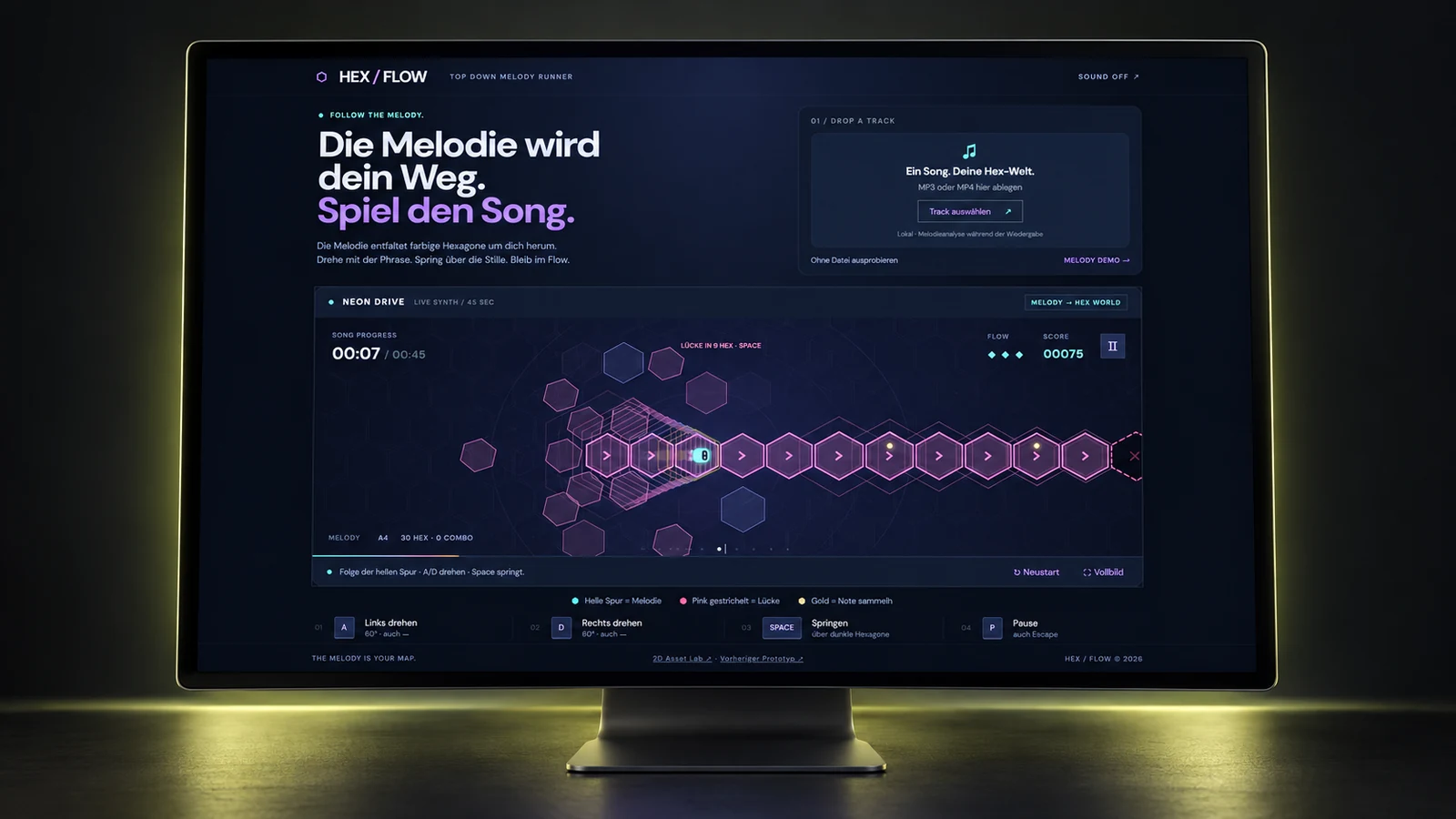
Adaptable clarification prompt — a retrospective improvement, not something already proven in this project
Before building, help me turn my music-game idea into concrete rules.
Explain the audio concepts in plain language. Offer three possible mappings from musical events to obstacles, movement or rewards.
For each option, describe exactly what the player will see and do, and what happens when the audio is quiet.
Ask me to choose one small mechanic to prototype. Do not invent the entire game from the phrase “make the music into a level.”
6. Play after each cycle. A test count is not a game-feel verdict.
I usually play the game once after each iteration, or watch Codex playing it. Sometimes reports about hundreds of shots or the current FPS are not what interests me at that moment. I want to see what happens when the game is actually used.
Technical checks still answer useful questions about bugs and performance. They do not decide whether the pace feels right or whether I want another round. I treat those as two separate checks: does the build behave, and does the experience work for me?
- Before changing a build, keep a version you can return to.
- After each cycle, play the core loop yourself or observe an actual playthrough.
- Describe one concrete mismatch: what you did, what happened, and what you expected.
- Ask the AI to reproduce and fix that mismatch before adding unrelated features.
- Recheck both the repaired behaviour and the parts you wanted to preserve.
- If the direction is wrong, make an explicit restart decision instead of endlessly patching around it.
A useful first milestone is a game you want to play again.
For me, high quality does not mean beginning with the largest feature list. It means bringing a clear human idea, finding assets that fit, testing a focused prototype, and noticing when sound, pace and interaction finally work together. Then I can decide whether to scale it, revise it or start a new version.
You can explore my public browser games, read how I built my own CMS with AI, or see five practical browser tools I built. The screenshots here document specific development builds; they are not promises that every project has a public playable release.